
Many educators lack formal training in pedagogy. As a result, they often depend too heavily on traditional lectures and slide presentations that are overcrowded with information. This situation is sometimes referred to as “death by PowerPoint,” leading to cognitive overload and poor information retention among students.
In this Webinar, Dr. Chiedozie Ike focused on the power of whiteboard animation as a tool for strengthening research integrity education. The session brought together researchers, educators, and open-science advocates to explore how visual storytelling can transform the way complex topics, especially research ethics, are taught across Africa and beyond. Throughout the webinar, he shared his journey from admirer of visual teaching methods to active animator and educator supported by the Science Integrity Alliance.
The presentation slides are available at https://africarxiv.ubuntunet.net/handle/1/10704
The recording will be made available here: AfricArXiv Open Science Webinar Series Recordings
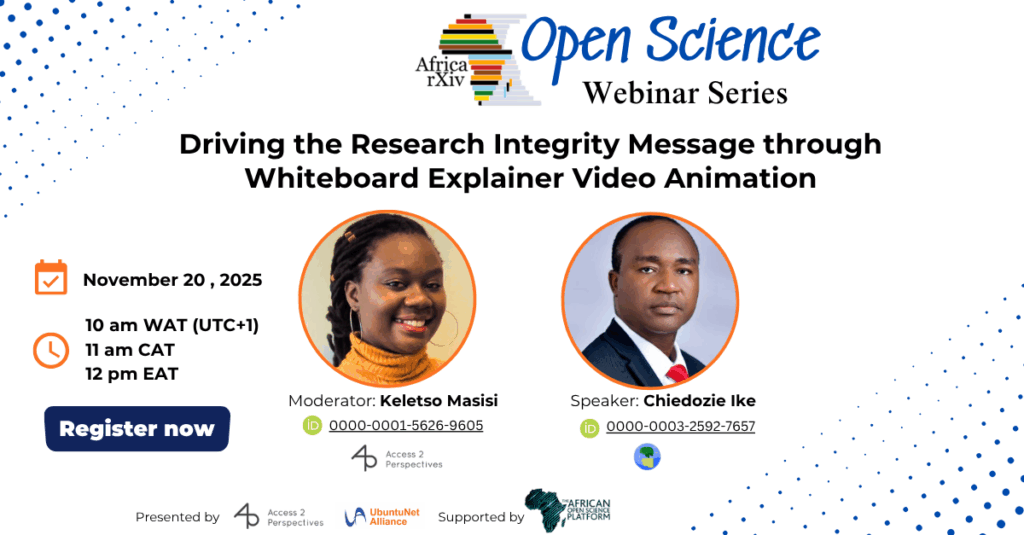
Discover how animation and storytelling can make research ethics engaging, relatable, and accessible for all. Learn how creative tools like Instadoddle and Voomly bring complex ethical ideas to life, supporting Open Science and education.
Tools Demonstrated
- InstaDoodle (AI-powered) – Used to generate scripts, slides, and animations
- Doodly – Popular for customizable whiteboard videos
- Vroomly – Another option for storytelling animations
- Different board styles: whiteboard, chalkboard, and glassboard
Dr Ike emphasized the need to train ethics educators to create their own whiteboard animations rather than depending on expensive external creators. He encouraged the formation of collaborative networks to share skills and resources, which can help scale engagement and improve inclusivity. The webinar featured a live demonstration of InstaDoodle’s AI wizard, which created a research ethics video in real time, showcasing how the technology can streamline content creation while highlighting the necessity of expert oversight to maintain cultural sensitivity and factual accuracy. Looking ahead, there will be research focused on how whiteboard animations influence learner attention and retention.
Speaker Profile

Dr. Chiedozie is a physician, university lecturer, and certified virtue ethics trainer in research integrity. He champions the use of animation, games, and storytelling to make ethics and integrity education engaging for learners of all ages. His work explores how creative tools can drive positive attitudes toward responsible science.
Linkedin: /chiedozie-ike-/
Orcid: 0000-0003-2592-7657
Q&A Session
What inspired you to use animation to deliver research integrity and ethics messages?
- I am naturally drawn to illustrations, and throughout my medical career, I have not only enjoyed illustrative texts but also seen and recognised the engaging and cognitive effects of audio-visual aids in learning.
- Animations, such as whiteboard doodle explainer videos, have a powerful effect on my students and conference attendees, and it’s a great time-saver when I have a lot to explain. So, each observed effect inspires me to use the approach more.
- Topics with a philosophical base, such as bioethics and research integrity, have concepts and theories that are not easy to understand for students or researchers in the sciences (STEM). So, with the result I got from my listeners/ audience and students about how I have made complex topics simple, I see a novel way to break down complex topics in research integrity and ethics.
- Seeing others use the tool with positive outcomes in addition to a plethora of empirical literature on the engaging and cognitive effects of whiteboard animations, I am more inspired to use animations in my training and classrooms.
How can video animation serve as an effective tool in promoting research integrity and ethics compared to traditional methods?
- First, it helps to break down complex ethical concepts, unlike the traditional method of teaching, where a lengthy time is needed (and expertise too) to explain these concepts and theories.
- The audio-visual effect on the human brain, especially the pre-frontal cortex, enhances sustained attention and understanding
- Because of the features-simple, hand-drawing, one image at a time, with synchronous audio and less crowded slides- it prevents cognitive load, which is a common finding in traditional methods of learning ethics and research integrity.
- Because of its effect on the brain system, the understanding of what is taught is retained for a longer time compared to the traditional teaching method.
- The inclusion of storytelling has a reinforced effect. Storytelling alone has a profound effect on learning, and when supported with animations, the effect is multiplied.
- Animations can be contextualised- images, sounds, the plot, and voiceovers can be modified to fit the environment, which is challenging to do with traditional training.
- The world is preoccupied with audio-visual technologies. So, it’s a more familiar environment than the traditional method of communication.
- Current thinking on ethics and research integrity encourages novel approaches, and one of them is audio-visuals, which includes animation.
- With animation, learners of all ages can understand key concepts in research integrity and ethics. In the younger age group, animation brings fun and learning together.
What are some of the key ethical challenges in research that you believe can be uniquely addressed through animated storytelling?
- The Use of AI in research- Artificial Intelligence as a co-author or as an assistant in research. Although there are so many discussions and publications on the use of AI in research, the discussions are usually technical, abstract and sometimes, concepts are inadequately explained, in addition to many theories, tools, and perspectives. Unfortunately, there is not enough time to engage the learners during those meetings. We need to tell the story and enjoy the images that are drawn while we learn the concepts.
- Decolonialisation/democratisation of research or knowledge- Often, there are so many concepts that are presented in a short time, leaving the listeners with a cognitive load. It’s amazing how many concepts are shared in a 45-60 minute webinar or discussion.
- Responsible or reforming research assessment and Open Science: There are cross-cutting concepts, nouns in words that are used interchangeably to describe concepts that underpin responsibility in research assessment and Open Science. While technical information is key to implementation, ensuring the engagement and understanding of the research community is key and that brings about the use of whiteboard animation in the dissemination approach.
Could you share an example from your experience where video animation helped clarify complex bioethics concepts for researchers or students?
- As an online bioethics course attendee: In 2016, I participated in an online bioethics course facilitated by Harvard X. The title of the course was: Bioethics: Law, Medicine and the Ethics and Law of Reproductive Technologies and Genetics. This course was my first experience with Doodly whiteboard explainer video animations. It is now almost a decade since I participated in that class, but the stories on surrogacy and enhancement still help to recall the lessons learned.
- As a medical school teacher, One of my first animated bioethics topics was on informed consent, breaking bad news and medical jurisprudence- The Death of Kamo and the Request for Autopsy: Medical Ethics and Medical Jurisprudence lecture 1. Although I have yet to assess the effects empirically, my students attest to how my animation helped them to understand complex subjects and how it helped them in the exams. Now, most of my lectures are being animated, from bioethics to research, research integrity, ethics, to clinical psychology. You could see some of the topics in my YouTube channel-https://www.youtube.com/@ScienceNArtAnimations
- As a conference speaker, I have used animations at a national conference in Nigeria- The EXCEL-RITE Conference, to explain informed consent and to describe how African values should be preserved in the informed consent process. At the same conference, I used animations to explain research policy. Note, this was my very first experience using an AI-powered whiteboard doodle animation. The videos are on my channel.
In your opinion, how does creativity in video animation impact the engagement and retention of ethical research practices among young and future scientists?
- The way the brain handles audio-visual images, especially the effects the sounds, the hand drawing, and the images are perceived by the different parts of the brain system that controls attention and cognition and how these work to retain to understand and retain information are possible explanations of the role of creativity in engagement and retention of learned skills or behaviour.
- Moreso, because stored information is reinforced when the same stimuli is excited. When scenarios that require the application of knowledge of research ethics occur, it is easy at least to know what is the right action to take. Applying that action is a factor of other influences such as the brain reward system, external influences such as impact of the applicaion, influence of role models, the research environment, mentorship and good supervision.
- When something is new, the brain sees it as something interesting. So, creativity is attractive to humans. If being creative attracts research integrity and ethics learners to training, it, therefore, suggests, that the more creative a trainer becomes, the more likelihood to attract learners and consequently, the more the number that possess the knowledge to practice the learned behaviour.
What advice would you give to institutions or educators wanting to develop video animation content that drives a culture of research integrity and ethical responsibility?
- Using whiteboard explainer video animation or any other type of animation techniques should be intentional; it should not be accidential but purposeful, justifiable, and with a determined heart.
- There are different animation techniques and software-Instadoodle, Doodly, Canva etc. Each comes with a cost and some have more steep learning curves than the others. Some are great for motion images, while some are suitable for explainer videos. So, teachers should study the types and the resources available before embarking on animation video creation.
- Animations take time to create, especially good ones. It takes upto 6-12 hours to create a simple 3-5 minutes video and this depends on proficiency, avilability of all information and accompanying softwares (especially voiceover and music software) before the creation and the level of details required. Where AI is used, the prompt skills, the loop-in-the expert times to correct hallucinations and other errors, the modification of outputs to fit the audience and ocassion, etc consume time. However, the more proficient the animator is the less time it takes.
- The educator or the institution should encourage the expert trainer to also learn to use the animation techniques; doing this cuts the time it takes to review the stories or the information after the animator has created it. More so, professional animators charge alot to produce a simple 3 minutes video. So, it’s cost-effective to have among the educators, an animator and the entire animation gadgets. Commercially produced animations are very expensive.
- Animations should be contexualised-audience type, time available, topic to be discussed, cultural mileu where the message is communicated, storage medium of the finished video, expected goal, outocme and impact.
- Invest in an expert animator to be on the research integrity and ethics education team and where possible, train a research integrity and ethics educator in video anmation; this is cost-effective.
References
- Website: https://www.scienceos.ai/about-us/
- Speaker’s Email: cg.ike@aauekpoma.edu.ng, time4virtue@gmail.com
- LinkedIn: https://www.linkedin.com/in/chiedozie-ike-94128524b
- The Recipient of the 8th WCRI, 2024 Anderson-Kleinert Diversity Award – https://www.wcrif.org/awards/anderson-kleinert-diversity-award
- ORCID: https://orcid.org/0000-0003-2592-7657
- Twitter: https://x.com/time4virtue_Ike
- YouTube Channel: https://www.youtube.com/@ScienceNArtAnimations
Related links
- Science Integrity Alliance website: https://www.sci-integrity.com/
This webinar demonstrated the transformative power of whiteboard animation and AI-assisted tools in fostering research integrity and enhancing the delivery of complex academic material. With growing interest in visual communication, educators across Africa have an opportunity to adopt these methods to make research ethics and many other challenging subjects more engaging, inclusive, and accessible.
This webinar series is co-organized by UbuntuNet Alliance (https://ubuntunet.net/) and Access 2 Perspectives (https://access2perspectives.org/) and supported by the African Open Science Platform (AOSP)