
Despite advances in open data, crucial questions remain about how data are being used and for what purposes. The Make Data Count initiative is driving progress on this front by developing tools and community practices that help better measure, understand, and recognize the use and impact of data as a key research output.
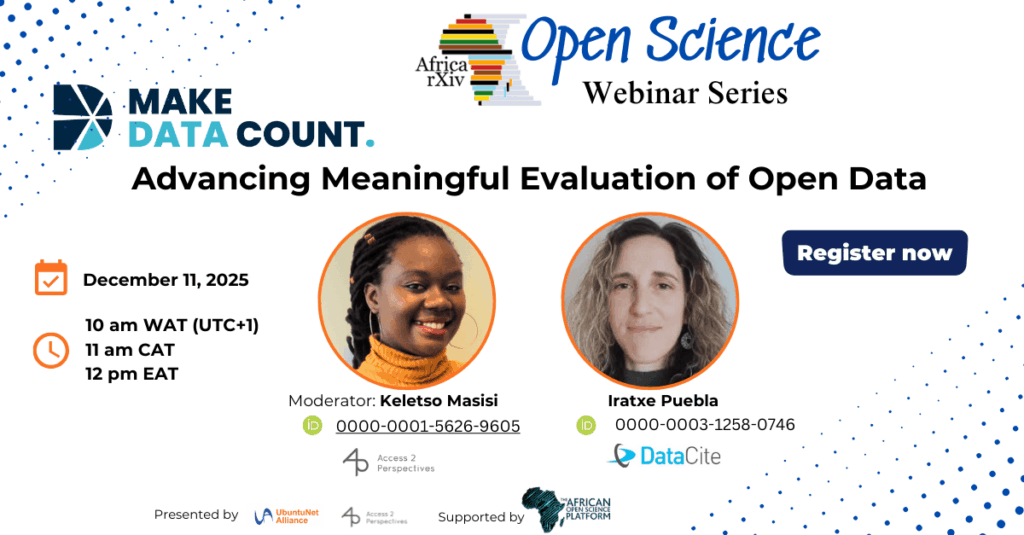
In this webinar presentation, Iratxe shares key updates from Make Data Count’s ongoing projects, including insights from the Data Citation Corpus, a large, open collection of data citations, and the work with HELIOS Open to advance the implementation of data evaluation in institutional assessment processes. She also highlights practical ways in which the community can get involved with data evaluation today.
Iratxe highlighted the importance of creating awareness on data sharing. She advocated for making data curation available for standardization, and testimonials shared to show that data sharing does not take away from the researcher.
The presentation slides are available at https://africarxiv.ubuntunet.net/handle/1/10702
The recording, once ready, will be made available here: AfricArXiv Open Science Webinar Series Recordings
Topics Covered:
- The importance of data evaluation and the role of open indicators of data use within the context of open data policies and practices.
- The infrastructure and tools available to capture and gain insights into the use of data, including data citations, views, and downloads.
- The Data Citation Corpus and the insights that can be gained on data use and reach through this resource.
- Resources for institutional data evaluation created by the ‘Implementing data evaluation in academia’ Working Group.
About Make Data Count
Make Data Count is a community initiative that promotes the development of open data metrics to enable the evaluation of data usage.
Website: https://datacite.org/, https://makedatacount.org/
LinkedIn: https://www.linkedin.com/company/make-data-count/
Blog: https://makedatacount.org/read-our-blog/
Bluesky: https://bsky.app/profile/makedatacount.bsky.social
PID Forum: https://pidforum.org/
Speaker Profile

Iratxe Puebla: Director, Make Data Count at DataCite.
Iratxe is passionate about open research and has experience in different areas of scholarly communications. Prior to Make Data Count, she supported the use of preprints and transparency in peer review at ASAPbio and held editorial roles at open-access journals, including PLOS ONE. She is also a publishing professional with 20 years of experience in scholarly communications.
LinkedIn: linkedin.com/in/iratxe-puebla
Q&A Session
- How can Make Data Count metrics be adapted to reflect the research priorities and data-sharing practices prevalent across diverse African research institutions and sectors? Make Data Count focuses on what happens with data after they are shared. I view the need to understand the use of data as common across settings and disciplines, because that is the information that will help us understand how data are being used, who is using the data, and who is underrepresented, and the diverse practices across sectors and communities. This information is needed to inform what to prioritize for each community to make data sharing more efficient, equitable, and rewarding for researchers
- What infrastructure gaps (e.g., repositories, persistent identifiers, internet access) need to be addressed in African countries to ensure accurate and scalable implementation of MDC-aligned data metrics? Make Data Count aims to advance recognition for data as a primary output, so we view it as important for datasets to be shared as their own research contribution, and not as corollaries to e.g. a research article via a supplemental file. The use of repositories is key toward this, to ensure the dataset has its own unique identifier and associated metadata. A good network of repositories is important, as well as the adoption of unique identifiers so that the metadata can be captured and shared via research-information workflows. Make Data Count deploys its workflows via DataCite services -e.g., data citations can be registered via the DataCite metadata schema-, so DataCite membership and use of its services is a good path to enable the collection of data-usage indicators.
- How can African universities and research organizations be supported to adopt MDC standards for tracking data usage, citations, and downloads, especially where digital systems are still emerging? The usage tracker provides a good implementation option for collecting and sharing data views and downloads per Make Data Count recommendations. This only requires a widget embedded on the dataset landing pages and the tracker completes the standardization of usage counts and reporting to DataCite. I recommend that repositories implement the tracker to start the collection of usage indicators.
- In what ways can MDC collaborate with African regional bodies (such as the African Open Science Platform or national science councils) to promote equitable visibility and impact measurement of African-generated data? I am eager to learn more about the data evaluation needs by those organizations. For example, the Data Citation Corpus provides links between data and other objects but we know that additional context is important for specific evaluation needs, we use this information to inform efforts toward metadata needs associated with citations. So I would be interested in learning about the priorities of African organizations: are they interested in data usage according to the specific country, language, discipline, or perhaps other factors important locally? This would help us evaluate what threshold of coverage we currently have in data-usage information for African-generated data, and inform future metadata priorities.
- What policies or incentives are needed at national or institutional levels in Africa to encourage researchers to share data openly and benefit from MDC-based metrics for academic recognition and career advancement? It is important to include data in research evaluation processes by institutions and funders. Policies by some funders require data sharing, but then datasets are not mentioned as part of the reporting of research contributions; datasets also need to be part of those reporting frameworks, to signal the expectation to report not only what data were created but also how they contributed to their research field and community. Funder and institutional policies should have text that articulates that data contributions can and should be reported, and guidance on how to describe the use and/or potential for impact of the data -e.g., via specific usage indicators, via a narrative description, or a relevant format.
Resources to Explore:
- https://open-science-monitoring.org/principles/
- https://upstream.force11.org/monitoring-open-science-survey/
- https://makedatacount.org/
- https://openscholarlyinfrastructure.org//
- https://makedatacount.org/explore-resources/resources-for-repositories-and-data-platforms/
- https://sfdora.org/
- https://schema.datacite
- https://force11.org/group/data-usage-typologies/
- https://makedatacount.org/explore-resources/institutions/
- https://localcontexts.org/
This webinar series is co-organized by UbuntuNet Alliance (https://ubuntunet.net/) and Access 2 Perspectives (https://access2perspectives.org/) and supported by the African Open Science Platform (AOSP)